KCNA Test Cram & KCNA Test Questions Answers
Wiki Article
DOWNLOAD the newest DumpExam KCNA PDF dumps from Cloud Storage for free: https://drive.google.com/open?id=14Phdz-VmJLgWOswBQuqlKFT7niWhhHC-
Linux Foundation KCNA reliable brain dumps are promised to help you clear your KCNA test certification with high scores. KCNA questions & answers will contain comprehensive knowledge, which will ensure high hit rate and best pass rate. When you choose KCNA Pdf Torrent, you will get your KCNA certification with ease, which will be the best choice to accelerate your career as a professional in the Information Technology industry.
Linux Foundation KCNA Certification Exam is an ideal choice for professionals looking to enhance their skills and advance their careers in the field of cloud-native computing. It is a comprehensive and rigorous exam that tests the candidate's knowledge and competency in Kubernetes and cloud-native computing. Kubernetes and Cloud Native Associate certification is recognized globally and provides access to a community of professionals who are passionate about cloud-native computing and Kubernetes.
KCNA Actual Real Questions & KCNA Test Guide & KCNA Exam Quiz
The Linux Foundation KCNA certificate stands out among the numerous certificates because its practicability and role to improve the clients stocks of knowledge and practical ability. Owning a test Kubernetes and Cloud Native Associate KCNA certificate equals owning a weighty calling card when the clients find jobs and the proof that the clients are the competent people.
The Kubernetes and Cloud Native Associate (KCNA) certification is an entry-level certification that is ideal for individuals who want to start their careers in the field of cloud-native technologies. Kubernetes and Cloud Native Associate certification offers a solid foundation in Kubernetes and cloud-native technologies, which are essential for building and managing modern applications in the cloud.
Linux Foundation KCNA Certification Exam is an excellent opportunity for individuals to demonstrate their expertise in Kubernetes and cloud-native technologies. With the increasing demand for cloud computing professionals, this certification can help individuals advance their careers and achieve their professional goals.
Linux Foundation Kubernetes and Cloud Native Associate Sample Questions (Q234-Q239):
NEW QUESTION # 234
What are cluster-wide objects
- A. ConfigMaps and Secrets
- B. Volumes and Nodes
- C. Service and Pods
Answer: B
Explanation:
https://kubernetes.io/docs/concepts/overview/working-with-objects/_print/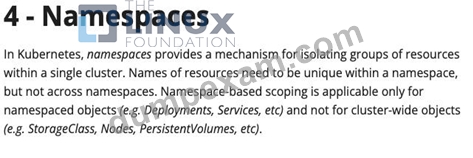
NEW QUESTION # 235
What is the common standard for Service Meshes?
- A. Service Mesh Technology (SMT)
- B. Service Mesh Function (SMF)
- C. Service Mesh Specification (SMS)
- D. Service Mesh Interface (SMI)
Answer: D
Explanation:
A widely referenced interoperability standard in the service mesh ecosystem is the Service Mesh Interface (SMI), so C is correct. SMI was created to provide a common set of APIs for basic service mesh capabilities-helping users avoid being locked into a single mesh implementation for core features. While service meshes differ in architecture and implementation (e.g., Istio, Linkerd, Consul), SMI aims to standardize how common behaviors are expressed.
In cloud native architecture, service meshes address cross-cutting concerns for service-to-service communication: traffic policies, observability, and security (mTLS, identity). Rather than baking these concerns into every application, a mesh typically introduces data-plane proxies and a control plane to manage policy and configuration. SMI sits above those implementations as a common API model.
The other options are not commonly used industry standards. You may see other efforts and emerging APIs, but among the listed choices, SMI is the recognized standard name that appears in cloud native discussions and tooling integrations.
Also note a practical nuance: even with SMI, not every mesh implements every SMI spec fully, and many users still adopt mesh-specific CRDs and APIs for advanced features. But for this question's framing-
"common standard"-Service Mesh Interface is the correct answer.
NEW QUESTION # 236
What are the two essential operations that the kube-scheduler normally performs?
- A. Filtering and scoring nodes
- B. Pod eviction or starting
- C. Resource monitoring and reporting
- D. Starting and terminating containers
Answer: A
Explanation:
The kube-scheduler is a core control plane component in Kubernetes responsible for assigning newly created Pods to appropriate nodes. Its primary responsibility is decision-making, not execution. To make an informed scheduling decision, the kube-scheduler performs two essential operations: filtering and scoring nodes.
The scheduling process begins when a Pod is created without a node assignment. The scheduler first evaluates all available nodes and applies a set of filtering rules. During this phase, nodes that do not meet the Pod's requirements are eliminated. Filtering criteria include resource availability (CPU and memory requests), node selectors, node affinity rules, taints and tolerations, volume constraints, and other policy-based conditions.
Any node that fails one or more of these checks is excluded from consideration.
Once filtering is complete, the scheduler moves on to the scoring phase. In this step, each remaining eligible node is assigned a score based on a collection of scoring plugins. These plugins evaluate factors such as resource utilization balance, affinity preferences, topology spread constraints, and custom scheduling policies.
The purpose of scoring is to rank nodes according to how well they satisfy the Pod's placement preferences.
The node with the highest total score is selected as the best candidate.
Option A is incorrect because Pod eviction is handled by other components such as the kubelet and controllers, and starting Pods is the responsibility of the kubelet. Option B is incorrect because resource monitoring and reporting are performed by components like metrics-server, not the scheduler. Option D is also incorrect because starting and terminating containers is entirely handled by the kubelet and the container runtime.
By separating filtering (eligibility) from scoring (preference), the kube-scheduler provides a flexible, extensible, and policy-driven scheduling mechanism. This design allows Kubernetes to support diverse workloads and advanced placement strategies while maintaining predictable scheduling behavior.
Therefore, the correct and verified answer is Option C: Filtering and scoring nodes, as documented in Kubernetes scheduling architecture.
NEW QUESTION # 237
In a cloud native environment, how do containerization and virtualization differ in terms of resource management?
- A. Containerization shares the host OS, while virtualization runs a full OS for each instance.
- B. Containerization uses hypervisors to manage resources, while virtualization does not.
- C. Containerization allocates resources per container, virtualization does not isolate them.
- D. Containerization consumes more memory than virtualization by default.
Answer: A
Explanation:
The fundamental difference between containerization and virtualization in a cloud native environment lies in how they manage and isolate resources, particularly with respect to the operating system. The correct description is that containerization shares the host operating system, while virtualization runs a full operating system for each instance, making option B the correct answer.
In virtualization, each virtual machine (VM) includes its own complete guest operating system running on top of a hypervisor. The hypervisor virtualizes hardware resources-CPU, memory, storage, and networking-and allocates them to each VM. Because every VM runs a full OS, virtualization introduces significant overhead in terms of memory usage, disk space, and startup time. However, it provides strong isolation between workloads, which is useful for running different operating systems or untrusted workloads on the same physical hardware.
In contrast, containerization operates at the operating system level rather than the hardware level. Containers share the host OS kernel and isolate applications using kernel features such as namespaces and control groups (cgroups). This design makes containers much lighter weight than virtual machines. Containers start faster, consume fewer resources, and allow higher workload density on the same infrastructure. Resource limits and isolation are still enforced, but without duplicating the entire operating system for each application instance.
Option A is incorrect because hypervisors are a core component of virtualization, not containerization. Option C is incorrect because containers generally consume less memory than virtual machines due to the absence of a full guest OS. Option D is incorrect because virtualization does isolate resources very strongly, while containers rely on OS-level isolation rather than hardware-level isolation.
In cloud native architectures, containerization is preferred for microservices and scalable workloads because of its efficiency and portability. Virtualization is still valuable for stronger isolation and heterogeneous operating systems. Therefore, Option B accurately captures the key resource management distinction between the two models.
NEW QUESTION # 238
What is the purpose of the 'nodeSelector" field in a Pod's YAML definition?
- A. To specify the pod's termination grace period.
- B. To specify the exact number of replicas for the pod.
- C. To restrict the pod's scheduling to nodes with specific labels.
- D. To define the pod's restart policy (Always, OnFailure, Never).
- E. To define the pod's image pull policy (Always, IfNotPresent, Never).
Answer: C
Explanation:
The •nodeSelectors field allows you to specify labels that the node must have in order for the pod to be scheduled on it. This provides a way to control where pods are placed based on node characteristics or roles.
NEW QUESTION # 239
......
KCNA Test Questions Answers: https://www.dumpexam.com/KCNA-valid-torrent.html
- Latest KCNA Test Sample ???? KCNA Exam Tutorials ???? New KCNA Dumps Files ???? Search for ➽ KCNA ???? and download it for free on ☀ www.examcollectionpass.com ️☀️ website ????KCNA Download
- KCNA Dumps Cost ???? KCNA Dumps Cost ???? KCNA Exam Tutorials ???? Immediately open ▛ www.pdfvce.com ▟ and search for ➥ KCNA ???? to obtain a free download ????KCNA Valid Test Notes
- Latest KCNA Test Sample ???? KCNA Valid Test Notes ???? KCNA Latest Exam Vce ???? Easily obtain free download of ⇛ KCNA ⇚ by searching on ☀ www.dumpsmaterials.com ️☀️ ????KCNA Cheap Dumps
- KCNA Valid Test Notes ???? KCNA Valid Test Notes ▶ KCNA Valid Exam Cram ???? Download ➽ KCNA ???? for free by simply entering “ www.pdfvce.com ” website ????Valid Dumps KCNA Ebook
- Free PDF The Best KCNA - Kubernetes and Cloud Native Associate Test Cram ???? ➤ www.pass4test.com ⮘ is best website to obtain ➽ KCNA ???? for free download ????KCNA Cheap Dumps
- Test KCNA Sample Questions ???? KCNA Valid Exam Pass4sure ???? Latest KCNA Test Sample ???? Enter ➤ www.pdfvce.com ⮘ and search for “ KCNA ” to download for free ????KCNA Valid Test Notes
- Important Features of www.examdiscuss.com Linux Foundation KCNA Exam Questions ???? Easily obtain free download of ➠ KCNA ???? by searching on ▛ www.examdiscuss.com ▟ ????KCNA Exam Brain Dumps
- New Study KCNA Questions ???? Test KCNA Sample Questions ???? Latest KCNA Test Sample ???? Download ➽ KCNA ???? for free by simply entering ▷ www.pdfvce.com ◁ website ????Test KCNA Sample Questions
- KCNA Download ???? KCNA Valid Exam Cram ???? KCNA Valid Exam Pass4sure ???? Easily obtain { KCNA } for free download through ☀ www.prepawayexam.com ️☀️ ????KCNA Boot Camp
- Important Features of Pdfvce Linux Foundation KCNA Exam Questions ???? The page for free download of ⮆ KCNA ⮄ on ➤ www.pdfvce.com ⮘ will open immediately ????KCNA Latest Exam Vce
- KCNA High Quality ???? Valid Dumps KCNA Ebook ???? Test KCNA Sample Questions ???? Simply search for ➠ KCNA ???? for free download on 《 www.prepawaypdf.com 》 ☸KCNA Trustworthy Exam Content
- myeasybookmarks.com, www.stes.tyc.edu.tw, wibki.com, georgiadsgo208294.blogdanica.com, lucyyyuz593160.wikievia.com, izaakwcjr790358.theisblog.com, matheyptv035756.smblogsites.com, bushraixgp843683.blazingblog.com, www.notebook.ai, liviaoehk755931.wikimillions.com, Disposable vapes
What's more, part of that DumpExam KCNA dumps now are free: https://drive.google.com/open?id=14Phdz-VmJLgWOswBQuqlKFT7niWhhHC-
Report this wiki page